 |
| Norway 2019-06-14 |
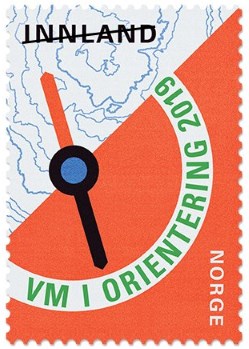
Member Tom sends information that on June 14, 2019 Norway Post issued a single stamp marking the upcoming 2019 World Orienteering Championships, taking place from August 12 – 17, 2019 in Østfold, Norway. Orienteering was invented by the Swedish military at the end of the 1800s. The first civil orienteering race was arranged in Norway in 1897 in Nordmarka, north of Oslo. The vertical formatted issue, designed in a map and compass motif is divided into two sections. The lower section, depicts an orange colored diagonal patch modeled on the international orienteering flag. The upper section of the stamp shows what appears to be topographic contour lines, shown in blue. Offset from the middle, the magnetic needle of the compass is visible, centered on the boundary between the upper and lower sections. Positioned through the orange patch following a circular path, much like the dial of a compass, is the Norwegian text “VM I Orientering 2019” meaning “World Championship in Orienteering 2019.” The non-denominated stamp is valid for domestic postage (INNLAND) up to 20 grams and sells for NOK 16.00 (USD 1.84). The stamp is available in booklets of 10. It appears there is no map in the selvedge of the booklet pane. [ always intricate and colorful, orienteering maps have been featured on a number of issues over the years. please contact us if you know about any web pages featuring more orienteering issues. – admin ]
Member Pierre sends news about a couple of new issues from the Monaco Post Philatelic Office. On May 29, 2019 two issues were released.
Centenary of the birth of Fausto Coppi…
 |
| Monaco 2019-05-29 |
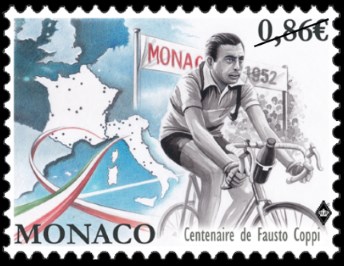
The first issue marks the centenary of the birth of legendary Italian cyclist Fausto Coppi. He was the dominant international cyclist of the years leading up to and directly following World War II. Coppi won the Italian Giro d’Italia five times and the Tour de France twice, along with the World Championship in 1953. In 1949, he became the first rider ever to win both the Tour de France and the Giro d’Italia, repeating that feat again in 1952, the same year that Monaco made its entry as a city stage in the Tour de France. The post site continues, “with an outstanding record, Fausto Coppi is widely seen as one of the greatest riders in the history of cycling. He revolutionized the approach to competitive sport with his focus on diet, technology, training methods and sporting medicine.” The horizontal formatted, 0.86€ denominated issue depicts a map on the multi-color left portion of the stamp, focused on France and Italy. On the map are a series of dots, inside of the boundaries of Italy and France, possibly indicating cities of the both Giro d’Italia and Tour de France that hosted stages of the races in 1952. Two multi-color ribbons, in the colors of the flags of Italy and Monaco are overlaid on the map, emanating from what appears to be Monaco and another Italian city of importance to the issue. On the monochrome right portion of the stamp is a pencil-like sketch of Coppi on his cycle, with a bottle between the handle bars. In the background is a banner reading “Monaco 1952” that changes from color on the left to monochrome on the right. [This is not the first stamp to depict Coppi, other issues from Italy, San Marino and other countries have, over the years, commemorated Coppi’s victories, although this may be the only issue with a map. Please let us know. -admin]
Women’s Football in France…
 |
| Monaco 2019-05-29 |
Another issue, marks France’s hosting of the FIFA Women’s World Cup 2019 soccer/football tournament taking place from June to July. The horizontal formatted, 1.05€ denominated issue depicts two players running to kick the ball. The “pitch” is depicted as a partial sphere of the Earth focused on western Europe and France, with the nine cities where the matches will take place shown as small gold stars on the map. A star-field is shown in the background. Along the left and right edges of the issue are 24 flags representing each team’s country or region.
Centenary of the Mediterranean Science Commission (CIESM)…
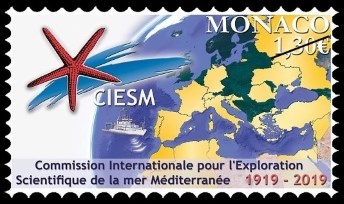
On March 15, 2019 a single stamp marking the centenary of the Mediterranean Science Commission (CIESM) was issued. The horizontal formatted, 1.30€ denominated issue depicts a map of the Mediterranean and Black Sea regions, with surrounding north African, the Middle-Eastern, and European countries visible. The 23 member states of CIESM are shown in yellow with their borders as white lines. A research ship with what is possibly a type of “sonar emitting depiction” radiating from the bow of the vessel and the logo of the CIESM, a red star-fish over an artistic blue “swash,” are visible on the left side of the stamp. The French title of the organization and centenary dates (1919-2019) are shown along the bottom of the stamp.
 |
| Monaco 2019-03-15 |
CIESM represents a unique forum for scientific exchanges, peace and dialogue, bringing together marine researchers from across the Mediterranean using the latest technologies to understand, monitor, and protect the sea. Today, with its multi-disciplinary network of 8,000 scientists working at almost 500 institutes, and with political support from its 23 member states, its independent analyses and recommendations are widely relied upon by national and international organizations.
All three issues are available in sheets of 10. There are no maps in the selvedge.
 |
| Belgium 2019-03-18 |
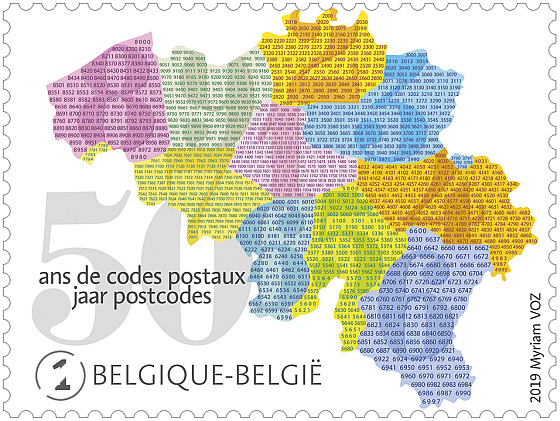
On March 18, 2019 Belgium Post issued a stamp marking the 50th anniversary of the establishment of postcodes in Belgium. The horizontal formatted and very colorful single issue depicts a map of Belgium “stylistically” divided into approximately nine sub-divisions each with a large numeral shown inside each, basically indicating the first digit of the postcode for that sub-division. In Belgium, postcodes consist exclusively of four numbers, ranging from 1000 to 9992. There are 1192 postcodes in use throughout Belgium. The number series are arranged regionally, with the design of the regions on the stamp roughly matching the provinces. The postcodes are written on the stamp in “micro text.” Available in sheets of 10, the non-denominated issue covers, what appears to be, standard domestic mail up to 50g. A large “1” in a circle [①] is shown in the lower left of the stamp. A large “50” with the text “ans de codes postaux jaar postcodes” is also shown on the left side of the issue. Postcodes were established in Belgium in 1969 where each postcode corresponded to a “commuanl section.” In 1990, these codes were revised with new codes being distributed to more than half of the municipalities. The goal of the revision was to match postcodes more closely with the provincial and municipal boundaries. The more zeros there are in the postcode, the higher the number of inhabitants of that represented city. Special numbers are reserved for the EU institutions, NATO headquarters, public and commercial broadcasters, and other public institutions.
 |
| Canada 2019-03-27 |
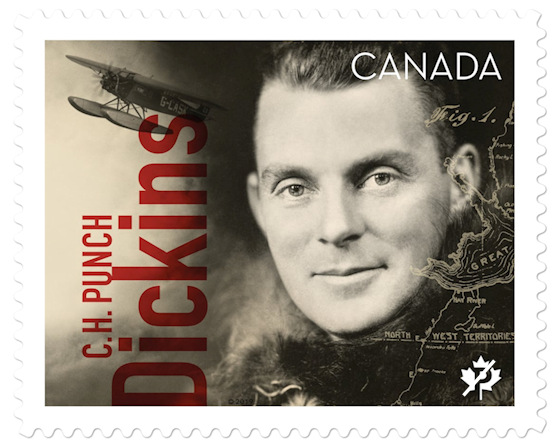
A map is featured on one of the stamps issued by Canada Post on March 27, 2019 honoring Canadian pioneers in flight. Of interest to cartophilatelists is the stamp featuring aviation pioneer and bush pilot C.H. “Punch” Dickins, who logged more than 1.6 million kilometers flying over Canada’s northern territories. A World War I flying ace and Distinguished Flying Cross recipient, Dickins made the first reconnaissance flight across the unmapped Barren Lands of the Northwest Territories. Part of a map of the Great Slave Lake in Canada’s Northern Territories is reproduced on the stamp. The horizontal formatted issue features a photograph of the young “Punch” (c.1927) dressed in a fur coat. In the upper left of the issue is an image of what appears to be Dickin’s Fokker “Super Universal” floating plane which he flew on mapping and reconnaissance flights over Canada’s, vastly uncharted north. On the right a “negative” image of a map showing a partial outline of the lake and area surrounding Yellowknife overlays the portrait of Dickins. The stamps are non-denominated, and cover the basic domestic letter rate, and are identified by the letter “P” inside a symbolic maple leaf icon on the stamp. The stamps are available in a booklet of 10 (two of each design) and a gummed mini-pane of five. [while researching this issue, a number of fascinating links were found, including what appears to be the official Dickins archive at the University of Alberta, in addition to those about Dickins and his many surveying and reconnaissance flights. this is not the first time Dickins was honored with a stamp. in 1982 Canada Post issued a stamp depicting Dickins’ famous Fokker “Super Universal” G-CASK plane (sc 972). an inquiry about a reference for the map used in the stamp was submitted. a reply is pending. -web admin]
 |
| Italy & Vatican City State, 2019-02 (planned) |
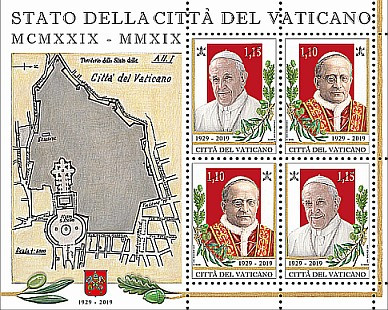
Fellow cartophilatelist and Vatican expert, James Hamilton, has informed us of an upcoming joint issue between the Vatican and Italian Posts, of a mini-sheet that contains a map of the City State in the selvedge. The mini-sheet marks the 90th anniversary of the Lateran Treaty which led to the establishment of Vatican City State (1929). The 4.15€ sheet contains a total of four stamps featuring Popes Pius XI and Francis. An antique looking large scale city plan, on the left of the sheets, depicts St. Peters Basilica and the boundary of the city state along with major roads. The issue is expected in February, however the is not shown on either web site yet. James also tells us of a Vatican issue, in a special folder, that appears to feature a map, but details are limited at this time.
 |
| Spain 2019-01-02 |
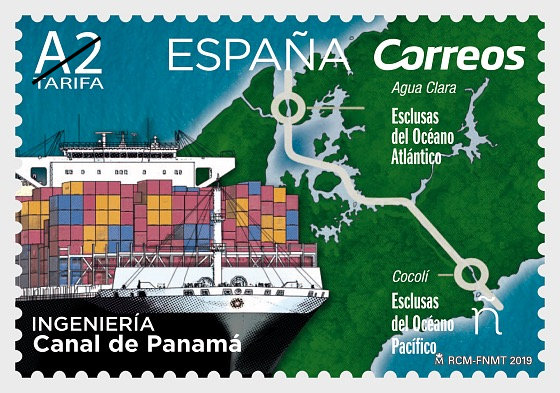
Member Emilio Jiménez Soler alerted use to what is most likely the first cartophilatelic issue of 2019! On January 2, 2019 Spain Post issued a single stamp marking Spain’s engineering contributions in building the Panama Canal and the recent expansion project. The A2 denominated (0,70€) issue depicts a map of the Panama Canal on the right side of the stamp. Locator symbols for both new sets of locks in the expansion project — the Agua Clara Locks (entrance from the Atlantic Ocean) and the Cocolí Locks (entrance from the Pacific Ocean) along with a generalized route line through the canal are overlaid on the map. The left side of the issue is an artist’s rendering of the bow of a large cargo vessel, with many stacks of containers on the deck. Information from the Spanish Post web site provides the following details about the canal and the engineering contributions from Spain. “A century ago, when the canal was initially being built, many Spaniards worked on its construction under the orders of the American engineers who carried out the great work. The recent new expansions to the canal were carried out by Spanish companies and that somehow closes that historical cycle and is another example of the relationship and commitment that Spain has with America. While the canal has served well over the past years, the was a need to expand and improve the infrastructure of the canal, with the aim of adapting it to the current needs of international trade and freight traffic. For this, a consortium formed by different companies, most of them Spanish, started a great project of renovation and improvement of the Panama Canal, in which the most important part of it includes the construction of two new sets of locks (located at the two markers on the map) that include a total of 16 floodgates, eight located on the Atlantic side and the remaining on the Pacific side. The stamp that recognizes the Spanish workers and companies involved in this project.” [always a fascinating engineering project to read about and a nice thematic stamp from Spain. Does anyone know what the “ñ” near the Cocoli Locks denotes? Is it an emboss for the visually impaired? On an actual stamp, it appears more muted in color. – web admin]
|
Welcome to the CartoPhilatelic Society Celebrating our 67th Year as a Society. Come and Join Us!
The CartoPhilatelic Society has entered our 68th year as a Society! In 1955 a group of philatelists with a keen interest in map stamps founded the CartoPhilatelic Society. Today we carry on their passion for map stamps in the collections we assemble and the research we conduct.
Come and join us as we look forward to the future!
Web Site Last Updated:
July 24, 2023
Our Visitors Map Updated 2015-09-21. Thanks to all 19941 unique visitors!

A one year term of membership for the CartoPhilatelic Society runs April 1 through
March 31. Unless you have pre-paid for multiple years, or renewed you dues, your membership has expired at the end of March 2023
If you have not yet paid, please continue to support the Society and renew your dues for the forth-coming term (April 2023 through March 2024) as soon as possible.

A big "Thank You!" to all those members who have recently renewed their membership! The CPS appreciates your continued support and donations.
Visit our Membership page for information.
|
|
 CPS Resource Centre