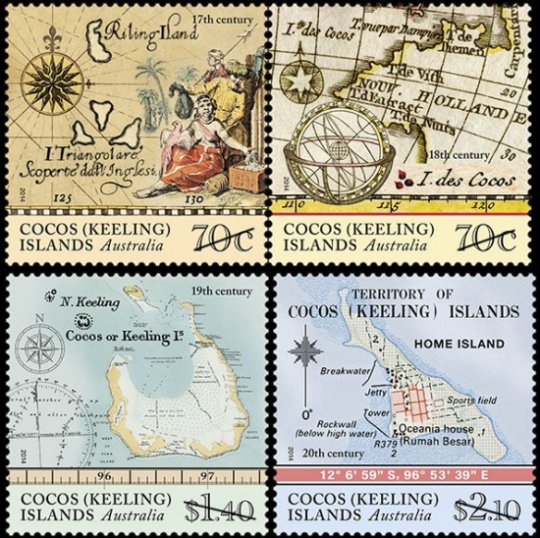
 Australia Cocos (Keeling) Islands, 2014-06-24 On June 24, 2014 Austraila Post issued a set of four map stamps depicting the Cocos (Keeling) islands from different periods during the islands’ history. The first European sighting of the Cocos (Keeling) Islands is thought to have been in 1609, by Englishman Captain William Keeling of the East India Company. Soon after, the two atolls that comprise the islands started to appear on maps. The stamps are composed of various maps from a particular century that show the atolls which comprise the Cocos (Keeling) islands. The 70c denomination is a joined pair, featuring maps of the 17th and 18th centuries. From the Australia Post web site, “a number of different maps and navigational charts have been used in the design of the four stamps, including: L’Arcano del Mare (Secrets of the Sea) (1646); Hemisphere oriental ou Ancien Monde (c. 1783); and Karte von dem Morgenlandischen Ocean oder dem Indischen Meere (1758). The single $1.40 denomination features a oceanagraphic chart from the 19th century. The single $2.10 denomination features a topographic map from the 20th century, with what appears to depict a large scale view of “Home Island,” one of the two inhabited islands in the group.
 Guernsey and Alderney, 20140730 Guernsey Post’s July 30th, 2014 issue from Alderney commemorating the life of British espionage author Ian Fleming features a “somewhat hidden” map. The set is comprised of six self-adhesive stamps, featuring black and white photographs of Fleming at various times during his lift. Denominations of the issue are 41p, 54p, 55p, 66p, 74p, and 83p. Also available is a £3 miniature sheet, and features Fleming driving a car resembling the one in his story, “Chitty Chitty Bang Bang.” The hidden map is shown here on the 54p stamp. Fleming is shown in the foreground with a map of the world on the wall behind him. Centered on the Pacific Ocean, Australia, New Zealand, the island of New Guinea are on the left, and South America on the right are all clearly visible on the map. An inscription reads, “The Life of Ian Fleming – Well traveled, he wrote vividly about the places he visited. ” The set of six singles are also available in sheets of ten, which additional descriptive text and images in the margins. From the web site, it was not clear if there are any more maps on the sheets, aside from the 54p issue.
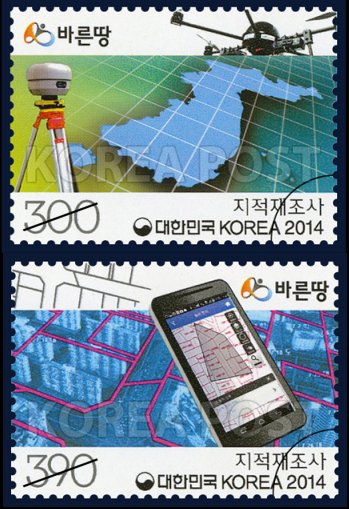 Korea 2014-03-20 On March 20, 2014 Korea Post issued two new stamps depicting a cadastral readjustment project taking place in the country. These fascinating stamps show a myriad of current high-tech devices used for surveying and mapping. The 300₩ stamp features what appears to be a GPS receiver of some type and a rotary aerial drone, whose intended use in this context, is probably aerial photography. In the background is a map graphic of the Korean peninsula. The 390₩ stamp features an Android smartphone, used as a mobile mapping terminal, with a cadastral map on the display showing what may be two different sets of parcel boundaries. In the background is what appears to be an oblique aerial image of an apartment complex overlaid with some vector GIS data depicting cadastral parcel boundaries. Both stamps are issued in the same joint sheet of 20 (4×5) format. A graphic of a satellite is shown in the upper right selvedge of the sheet. [ some geospatial colleagues in the Korean government pointed out this article, in Korean, which describes the project. another article in English was published in August 2013. this is not the first depiction of a smartphone on a stamp however it may be the first time where a map is shown on the display and the device’s intended use is for field-surveying. also, while this is not the first UAV/drone to be depicted on a stamp, we think this is the first time a rotary UAV has been shown on a stamp. we welcome any additional information and discussion on this very unique and timely cartophilatelic issue. — web admin ]
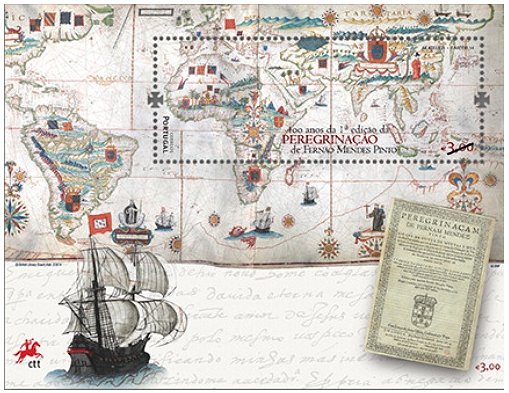 Portugal 2014-02-24 On February 24, 2014 Portuguese Post issued a souvenir sheet and single stamp to mark the 400th anniversary of the publishing of Fernão Mendes Pinto’s Pilgrimage (Peregrinação). Pinto was a a Portuguese explorer and writer and the work is considered an autobiographical account of his travels and voyages throughout India, Asia and the far east. The Pilgrimage was published posthumously in 1614 and many historians have doubted the truthfulness of his many interesting stories. The €3.00 sheet features a single long stamp. A world map “Mapa do Mundo de Antonio Sanches, 1623” is shown in the background and covers about 70% of the sheet. The lower 30% of the sheet is covered by hand writing of what could be journal entries. The stamp is in the upper right hand section of the sheet, covering the continents of Africa and Asia, as depicted in the antique world map. In the bottom left corner is a sailing ship of the period and in the bottom right corner is the cover page of the Pilgrimage. The single €1.00 issue features some of the same motifs from the sheet, however there is no map.
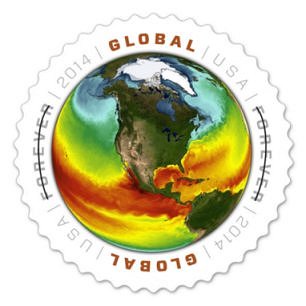 USA 2014-04-22 As a very fitting observance of Earth Day, the US Postal Service issued “Sea Surface Temperatures,” a new global forever stamp on April 22, 2014. The circular self-adhesive is valid for the $1.15 international forever rate, and is the second Global Forever issue to be of interest to cartophilatelists. The stamp depicts a representation of sea surface temperatures brightly colored in the ocean areas, while the land masses of north and south America and covered by a natural color satellite mosaic. “The image is one frame in a 1,460-frame animation created from the output of a computer model of Earth’s climate by the National Oceanic and Atmospheric Administration’s Geophysical Fluid Dynamics Laboratory. The full animation shows how the surface temperatures of the oceans vary seasonally and change over time, and how surface ocean currents and eddies transport heat and water around the globe.” While the web site did not describe the data used, the sea surface temperatures could be derived from MODIS Aqua data and the natural color mosaic also MODIS or Blue Marble. [ please contact us if you know the details of the platforms/sensors/data depicted in this stamp –web admin ]
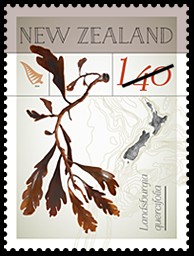 New Zealand 2014-02-05 ($1.40) On February 5, 2014 New Zealand Post issued a new set of five stamps depicting native seaweeds of New Zealand. From the web site, New Zealand’s unique marine environment is home to nearly 900 species of native seaweed, a third of which occur nowhere else in the world. Seaweeds are an essential part of the marine ecosystem, providing food, habitats and shelter to a wide variety of marine life. This stamp issue reflects New Zealand’s remarkable marine biodiversity, and the five unique seaweeds portrayed are Hormosira banksii (70cents), Landsburgia quercifolia ($1.40) [shown at right], Caulerpa brownii ($1.90), Marginariella boryana ($2.40) and Pterocladia lucida ($2.90). The mini-sheet contains the same set of stamps. What appears to be a monochrome relief map of New Zealand, surrounded by bathymetric contours is shown on each stamp. Bathymetric contours are partially visible on the left edge of the mini-sheet. [thanks for the information Ingwi! -admin]
|
Welcome to the CartoPhilatelic Society Celebrating our 67th Year as a Society. Come and Join Us!
The CartoPhilatelic Society has entered our 68th year as a Society! In 1955 a group of philatelists with a keen interest in map stamps founded the CartoPhilatelic Society. Today we carry on their passion for map stamps in the collections we assemble and the research we conduct.
Come and join us as we look forward to the future!
Web Site Last Updated:
July 24, 2023
Our Visitors Map Updated 2015-09-21. Thanks to all 19941 unique visitors!

A one year term of membership for the CartoPhilatelic Society runs April 1 through
March 31. Unless you have pre-paid for multiple years, or renewed you dues, your membership has expired at the end of March 2023
If you have not yet paid, please continue to support the Society and renew your dues for the forth-coming term (April 2023 through March 2024) as soon as possible.

A big "Thank You!" to all those members who have recently renewed their membership! The CPS appreciates your continued support and donations.
Visit our Membership page for information.
|
|
 CPS Resource Centre