Article Number 11: Newly Discovered London to London Proof Enriches Saga of Rarest Map Stamp
New Submission July 2010, Research, text and scans by Miklos Pinther
Our eleventh Marginalia submitted by Society President Emeritus Miklos Pinther describes the fascinating events behind the recent discovery of a press-proof of the famous London to London stamp. — web admin
An old collector friend of mine periodically reminds me that just when one thinks he knows everything about an item, a surprise comes along. A few months ago, such an unforeseen event astonished the cognoscenti of the Canadian philatelic circle. It concerned the 1927 “London to London” stamp.
Readers may recall that during the time when pioneering transatlantic flights were attempted, Carling Brewery of London, Ontario decided to jump into the race and support such an undertaking. It provided the aircraft, named “Sir John Carling” after the founder of the brewery, and offered a $25,000 prize to the pilots if successful. After some weather related delay, the pilots Captain Terrance B. Tully and Lt. James V. Medcalf took off from St. John’s , Newfoundland , on September 7, 1927 . Unfortunately, they never made it to England . The plane disappeared over the Ocean without a trace along with a packet of commemorative mail with specially printed 25 cent stamps.[i] Very few of the stamps and only one cover are known. The latter was removed from the plane just before it took off. Recently this cover resurfaced and was sold by Harmers of London for £70,575 on April 6, 2004 .
At the time, Harmers reported that only six mint examples of the stamp are known, and I noted further that one of them is to be found in the Allan Lee Collection.[ii] Subsequently, I was corrected by the curator of the National Postal Museum . The stamp in Allan’s collection is a mere copy of the original.
Two years later, in a detailed exposé in “Scott Stamp Monthly,” Charles J. G. Verge traced the history of this stamp of which now nine copies are known.[iii] The ninth copy surfaced in 2006. It was owned by Mac Geldert, former president of the Royal Philatelic Society of Canada, who gave it to his daughter. Described by Charles Shreves as “the most attractive of these six [the six known in private hands] with its impeccable centering,” the stamp was sold for $18,000.00 by Shreves Philatelic Galleries, Inc. on October 28, 2006 . The buyer remains anonymous.
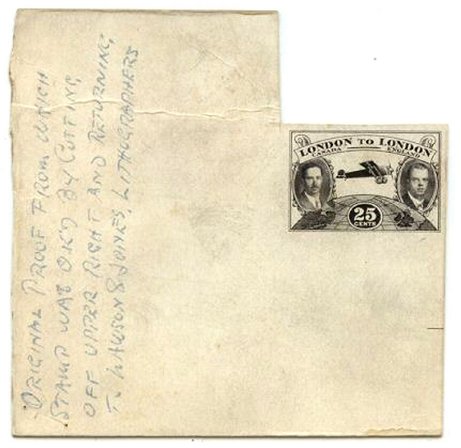
Figure 1. The London to London plate proof with the following note, “Original proof from which stamp was O.K.’d by cutting off upper right and returning to Lawson & Jones, Lithographers.”
Now to return to the surprising new find. In December 2008, after being hidden for virtually 81 years, a Toronto banker, John Harding, Jr., rediscovered a printer’s proof of the London to London stamp in a sock drawer (Figure 1.). Brett Popplewell of the Toronto Star quoted Harding earlier this year saying, “People told my father it was worth something… He kept it in a box in his attic for the better part of 40 years. Then he gave it to me and said ‘See what you can get for it someday.’”[iv] Not being a philatelist Harding first put the item up on eBay. Almost immediately, however, he was convinced by John H. Talman, a Toronto stamp dealer, to take it off and offer it instead for sale at his December 19th auction. The lot was estimated at $3,000.00, but after what was described as a “bidding war,” it was hammered down at $10,000.00 “to an anonymous American collector.”[v] Banker Harding and stamp dealer Talman were happy. But is this the end of the story? Was the price realized fair for an obviously unique item of one of Canada ’s rarest stamps?
All things considered, it was still unexpected to see this item come on the market again in April, only four months later. It was offered for sale by Charles G. Firby Auctions on April 23, 2009 . Charles Firby is an expert on Canadian stamps and is one of the premier auctioneers in this area. The lot was now described in much more detail. It called attention to the handwritten note on the proof and the envelope (Figure 2.) in which the proof was kept: “Accompanying the proof is the envelope in which it has resided since 1927. The corner card is of the Carty News Service which directly ties the content to this flight. Mr. Arthur C. Carty, of the News Service, was also the manager of the Sir John Carling Flight that we now call the London to London Flight.”[vi] The lot, now with a 2009 V. G. Greene certificate of genuineness, sold for $35,000.00, which is more in line what collectors have been willing to pay for the single stamps.
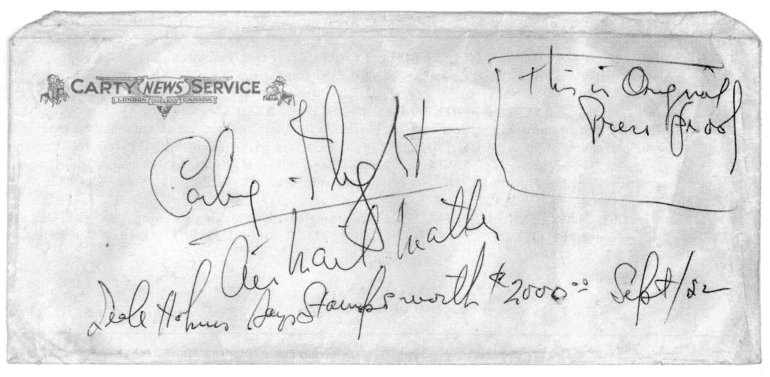
Figure 2. Carty News Service envelope with the following ms notations, “Carling Flight,” “Air Mail Matter,” “This is Original Press proof,” Seale Holmes Says Stamps worth $2,000.00 Sept/52.”
Following the auction I contacted Charles Firby to inquire about the provenance of this plate proof. It turns out that he was the “anonymous American buyer” who bought the item from John Talman, which he then sold in his own auction to Ray Simrak, a noted Canadian aerophilatelist.[vii]
[i] Listed under “Air Post Semi-Officials,” catalog number CLP6, in Unitrade Specialized Catalogue of Canadian Stamps.
[ii] Miklos Pinther, “Literature Notes” in The New CartoPhilatelist, Whole Number 6, July 2004, page 4 and 7.
[iii] Charles J. G. Verge, “Remarkable new London-to-London stamp discovery turns up more examples” in Scott Stamp Monthly, August 2006, pages 24 to 30.
[iv] Brett Popplewell, “Stamp found in sock drawer reopens 1927 intrigue” in Toronto Star, January 11, 2009 , page A1.
[v] Ibid. See also www.talmanstamps.com/auctions.html
[vi] See http://www.firbyauctions.com/6928/index.html, lot 788. See also “The Flight of the Sir John Carling, London to London 1927,” in Gibbons Stamp Monthly, Vol. 39, No. 12, May 2009, pages 61-62.
[vii] Information concerning the sale of this item and the illustrations are reproduced with the kind permission of Charles G. Firby.
 CPS Resource Centre