CPS Resource Centre
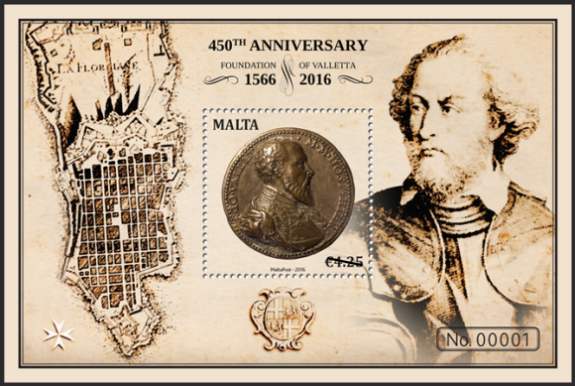
On March 28, 2016 Malta Post issued a souvenir sheet making the 450th anniversary of the Foundation of Valletta. Much fascinating information can be found about the history of Malta. The Wikipedia entry about Valletta describes the Great Siege of 1565, when Fort Saint Elmo fell to the Ottomans, but the Order of St. John eventually won the siege with the help of the Spanish.
Malta 2016-03-28
The victorious Grand Master, Jean de Valette, immediately began to build a new fortified city on Sciberras Peninsula to fortify the Order’s position in Malta and bind the Knights to the island. The city took his name and was called La Valletta. The Malta Post website adds some additional information. On March 28th 1566 a foundation stone bearing the eight-pointed cross was placed near the gate to what was to become the new city. The site was decorated with flags, some of which depicted the emblem of the Order and that of the Grand-master. Legend has it that coins in circulation together with some specially minted ones as well as medals were placed inside a lead cup together with the stone and embedded in the masonry. The single stamp souvenir sheet depicts an image of de Valette on the right. The €4.25 denominated stamp, possibly depicting one of the specially minted coins, is shown in the center of the sheet. Below the stamp appears to be a heraldic escutcheon, possibly de Valette’s. On the left of the sheet is an antique city plan of the new city and fortifications, that later would become the capitol of Malta. The entire city of Valletta was designated a UNESCO World Heritage Site in 1980, and has been selected as the European Capital of Culture for 2018. As a result, various restoration projects are under way. [if anyone has a reference for the city plan shown on the souvenir sheet, please let us know. a quick image search of Valetta turned up a number of nice looking maps, including this large scale AMS 1943 topographic city plan from the magnificent online archive at the University of Austin’s Perry-Castañeda Library Map Collection. -admin]