Netherlands Antilles: New Countries – New Map Stamps

A final declaration agreement between the Netherlands Antilles and the Netherlands went into force on October 10, 2010, completing the process of constitutional reform in the Antilles. Curaçao and St Maarten have become autonomous countries within the Kingdom of the Netherlands. Bonaire, St Eustatius and Saba will become special municipalities of the Netherlands. The change in autonomy has also been documented in the October 25th, 2010 edition of Linn’s Stamp News, page 2.

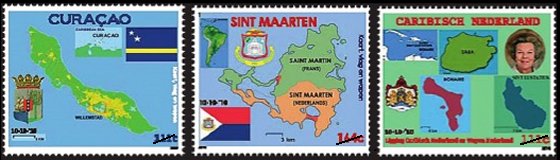
Netherlands Antillies : Curaçao, Saint Maarten 2010-10-10

Mark Honig, the Society’s Vice President, who hails from the Netherlands, has sent these images of new stamps issued to mark the new autonomy. Three stamps were issued on October 10,2010, in denominations of 111c and 164c. All three stamps depict maps. The map of Curaçao shows the urban areas of the island in yellow. The map of St. Maarten shows both the French (north) and Dutch (south) zones of the island. Both capitals are shown in red. The final stamp shows the remaining non-autonomous Netherlands Antilles, after the declaration. On January 1, 2011, Curaçao and St. Maarten will begin to use a new currency, probably on a 1 to 1 parity with the present Netherlands Antilles Guilder. We can assume these stamps will change at that time, as these denominations will be incorrect. The small Caribbean Netherlands islands of Bonaire, Saba and St. Eustatius will use the US dollar from Jan 1, 2011. [thanks to Mark for the heads-up and fact checking! — web admin]

Report on the 4th Meeting of the CartoPhilatelic Society, August 2010

The 4th meeting of the CartoPhilatelic Society was held during the APS Stamp Show 2010 in Richmond VA, August 12 – 15, 2010. The Richmond show was extensive, with at least 150 dealers and over 900 exhibit frames.

Three members of the Society, attended the meeting in Richmond on August 14. Martin Oakes, the editor of the Society’s Journal demonstrated a new macro that he is developing that will allow users to integrate an updated Excel version of the Map on Stamps Checklist with the user’s personal copy of an older version. Sometime the user will annotate the checklist with notes and additional information. The macro will allow a smooth integration of the old and new Checklists without losing personal comments or creating duplicate entries.

Martin expects the macro to be completed by year-end. It was decided to issue Rev. 5 of the Checklist to coincide with the completion of the macro.

We also discussed the possibility of using MagCloud to print and distribute The New CartoPhilatelist. An actual test was carried out using MagCloud to produce the October 2010 issue. The group also discussed having the Checklist available to members online.

Marginalia: August 2010 “Bridge of Spies”

Article Number 12:  “Bridge of Spies” on a Map Stamp

New Submission August 2010,  Research, text and scans by Volker F. Woesner

With the recent spy exchange between the US and Russian governments, reminiscent of previous Cold War times, Volker introduces us to an interesting German map stamp. Read more to learn about this unique issue in the 12th Marginalia entry. –web admin

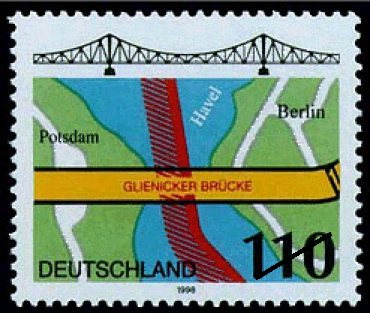
“ Bridge of Spies ” Germany , 1998, sc1988

I do not know much about bridges for spies only.  But I know that one of these bridges is featured on a map stamp. It is the “ GlienickeBridge ” near Berlin.

This bridge was one of the most famous bridges until 1989. It was the “ Bridge of Spies ” in times of the Cold War. The bridge crosses the Havel River/Iron Curtain between the former communist Potsdam and the free West Berlin .

Access to the bridge had only captured Russian or US spies. The bridge was built in 1907 and connected the city of Potsdam with the city of Berlin .

The Soviet Union on one side of the Iron Curtain and the US on the other side used this bridge to exchange captured spies during those times.

One of the most famous exchanges took place on February 10, 1962. The US exchanged the Russian spy Rudolf Abel for the pilot of the US reconnaissance plane U-2, Gary Powers, who was captured by the USSR .

The last big prisoner exchange on this bridge took place in 1986.

Marginalia: July 2010, Newly Found London to London Proof

Article Number 11:  Newly Discovered London to London Proof Enriches Saga of Rarest Map Stamp

New Submission July 2010,  Research, text and scans by Miklos Pinther

Our eleventh Marginalia submitted by Society President Emeritus Miklos Pinther describes the fascinating events behind the recent discovery of a press-proof of the famous London to London stamp. — web admin


An old collector friend of mine periodically reminds me that just when one thinks he knows everything about an item, a surprise comes along.  A few months ago, such an unforeseen event astonished the cognoscenti of the Canadian philatelic circle.  It concerned the 1927 “London to London” stamp.

Readers may recall that during the time when pioneering transatlantic flights were attempted, Carling Brewery of London, Ontario decided to jump into the race and support such an undertaking.  It provided the aircraft, named “Sir John Carling” after the founder of the brewery, and offered a $25,000 prize to the pilots if successful.  After some weather related delay, the pilots Captain Terrance B. Tully and Lt. James V. Medcalf took off from St. John’s , Newfoundland , on September 7, 1927 .  Unfortunately, they never made it to England .  The plane disappeared over the Ocean without a trace along with a packet of commemorative mail with specially printed 25 cent stamps.[i]  Very few of the stamps and only one cover are known.  The latter was removed from the plane just before it took off.  Recently this cover resurfaced and was sold by Harmers of London for £70,575 on April 6, 2004 .

At the time, Harmers reported that only six mint examples of the stamp are known, and I noted further that one of them is to be found in the Allan Lee Collection.[ii]  Subsequently, I was corrected by the curator of the National Postal Museum .  The stamp in Allan’s collection is a mere copy of the original.

Two years later, in a detailed exposé in “Scott Stamp Monthly,” Charles J. G. Verge traced the history of this stamp of which now nine copies are known.[iii]  The ninth copy surfaced in 2006.  It was owned by Mac Geldert, former president of the Royal Philatelic Society of Canada, who gave it to his daughter.  Described by Charles Shreves as “the most attractive of these six [the six known in private hands] with its impeccable centering,” the stamp was sold for $18,000.00 by Shreves Philatelic Galleries, Inc. on October 28, 2006 .   The buyer remains anonymous.
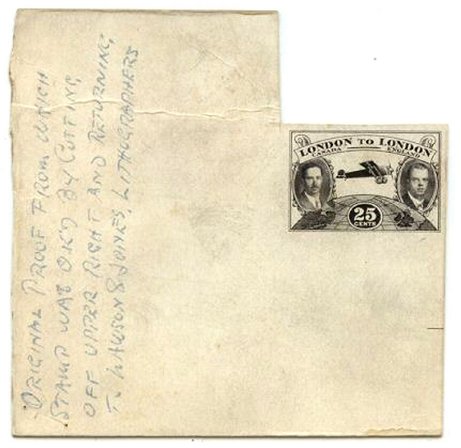
Figure 1. The London to London plate proof with the following note, “Original proof from which stamp was O.K.’d by cutting off upper right and returning to Lawson & Jones, Lithographers.”

Now to return to the surprising new find.  In December 2008, after being hidden for virtually 81 years, a Toronto banker, John Harding, Jr., rediscovered a printer’s proof of the London to London stamp in a sock drawer (Figure 1.).  Brett Popplewell of the Toronto Star quoted Harding earlier this year saying, “People told my father it was worth something… He kept it in a box in his attic for the better part of 40 years.  Then he gave it to me and said ‘See what you can get for it someday.’”[iv]  Not being a philatelist Harding first put the item up on eBay.  Almost immediately, however, he was convinced by John H. Talman, a Toronto stamp dealer, to take it off and offer it instead for sale at his December 19th auction.  The lot was estimated at $3,000.00, but after what was described as a “bidding war,” it was hammered down at $10,000.00 “to an anonymous American collector.”[v]  Banker Harding and stamp dealer Talman were happy.  But is this the end of the story?  Was the price realized fair for an obviously unique item of one of Canada ’s rarest stamps?

All things considered, it was still unexpected to see this item come on the market again in April, only four months later.  It was offered for sale by Charles G. Firby Auctions on April 23, 2009 .  Charles Firby is an expert on Canadian stamps and is one of the premier auctioneers in this area.  The lot was now described in much more detail.  It called attention to the handwritten note on the proof and the envelope (Figure 2.) in which the proof was kept:  “Accompanying the proof is the envelope in which it has resided since 1927.  The corner card is of the Carty News Service which directly ties the content to this flight.  Mr. Arthur C. Carty, of the News Service, was also the manager of the Sir John Carling Flight that we now call the London to London Flight.”[vi]  The lot, now with a 2009 V. G. Greene certificate of genuineness, sold for $35,000.00, which is more in line what collectors have been willing to pay for the single stamps.
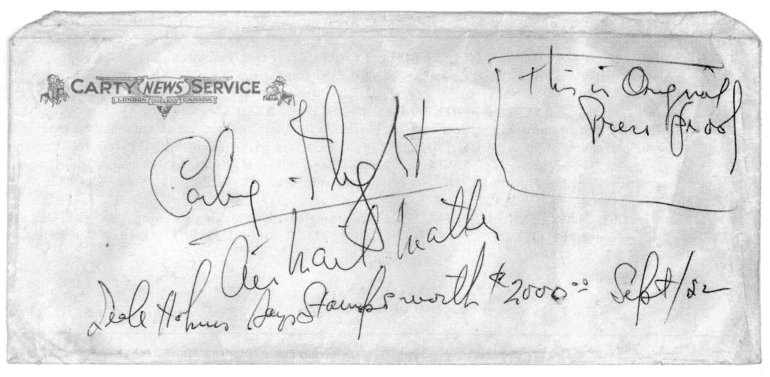
Figure 2. Carty News Service envelope with the following ms notations, “Carling Flight,” “Air Mail Matter,” “This is Original Press proof,” Seale Holmes Says Stamps worth $2,000.00 Sept/52.”

Following the auction I contacted Charles Firby to inquire about the provenance of this plate proof.  It turns out that he was the “anonymous American buyer” who bought the item from John Talman, which he then sold in his own auction to Ray Simrak, a noted Canadian aerophilatelist.[vii]


[i]  Listed under “Air Post Semi-Officials,” catalog number CLP6, in Unitrade Specialized Catalogue of Canadian Stamps.

[ii]  Miklos Pinther, “Literature Notes” in The New CartoPhilatelist, Whole Number 6, July 2004, page 4 and 7.

[iii]  Charles J. G. Verge, “Remarkable new London-to-London stamp discovery turns up more examples” in Scott Stamp Monthly, August 2006, pages 24 to 30.

[iv]  Brett Popplewell, “Stamp found in sock drawer reopens 1927 intrigue” in Toronto Star, January 11, 2009 , page A1.

[v]  Ibid.  See also www.talmanstamps.com/auctions.html

[vi]  See http://www.firbyauctions.com/6928/index.html, lot 788.  See also “The Flight of the Sir John Carling, London to London 1927,” in Gibbons Stamp Monthly, Vol. 39, No. 12, May 2009, pages 61-62.

[vii]  Information concerning the sale of this item and the illustrations are reproduced with the kind permission of Charles G. Firby.

Europa 2010 Issues 1: Guernsey

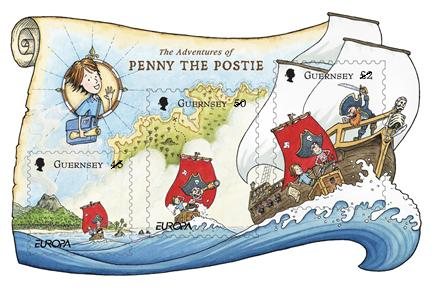
Children’s story books are the theme of the 2010 Europa issues. This year it appears that maps are contained in the stamps of two issuing countries. Originally issued in 1956, the Europa issues are currently issued by each postal authority under the guidance of PostEurop. The first issue that contains a map is this colorful issue from Guernsey Post. The May 4, 2010 issue consists of three adhesive stamps and a Souvenir sheet. The map design is shown in the background of the souvenir sheet. A large part of the map design is contained on the 50 pence stamp. A very small section is also depicted in the upper right corner of the 45 pence stamp. The best view of the map is shown below in on the £2.95 souvenir sheet.

Guernsey 2010-05-04 mini-sheet

To support this year’s Europa theme, Guernsey Post created their own fictional children’s character named Penny the Postie. Designer Keith Robinson, who also designed Guernsey Post’s Alderney Sherlock Holmes stamps, has written and illustrated The Adventures of Penny the Postie, a locally set story that sees Penny embark on an amazing journey. “Having come across a strange old postbox, she soon finds herself on a desert island helping a pirate outwit the mean Captain Bullybones who has stolen his ship. But will Penny be able to get home to Guernsey?”

Europa 2010 Issues 2: Monaco

Children’s story books are the theme of the 2010 Europa issues. This year it appears that maps are contained in the stamps of two issuing countries. Originally issued in 1956, the Europa issues are currently issued by each postal authority under the guidance of PostEurop. The second issue containing a map is from the Stamp Issuing Office of the Principality of Monaco.

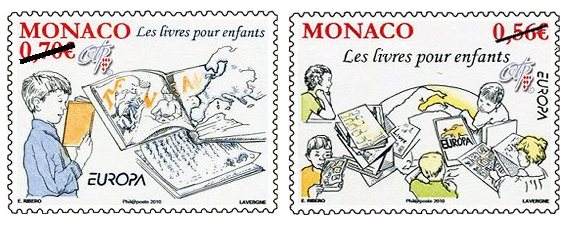
Monaco 2010-05-05

Monaco has submitted two stamps for the 2010 Europa issue and each of them contain a small generalized map. The first stamp in the May 5, 2010 issue is a 0,70€ denomination, entitled “Open Book” and depicts a young boy reading a book, with a larger picture showing a an open book with a map of Europe “springing” from the pages. The second stamp, a 0,56€ denomination entitled “Children and the World” show a group of children talking and reading various books with a very generalized globe in the background of the stamp.